

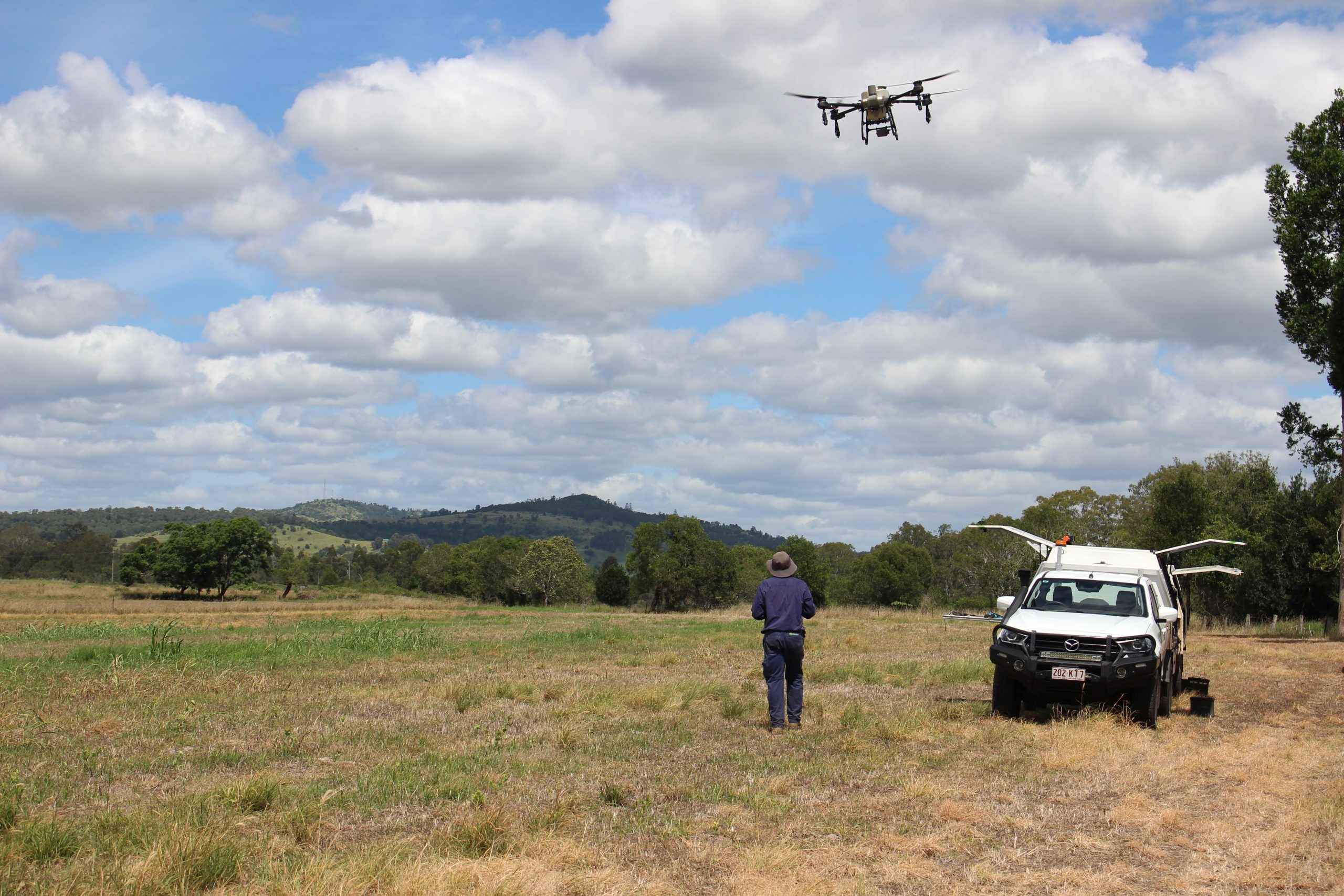
It’s the first thing most farmers ask us, and fair enough. You want to know whether a drone can get your job done quickly, or you’re trying to work out a price in your head. The honest answer is that it’s hard to say without knowing the job and the country it’s on. As a guide, we cover about 1 to 10 hectares an hour spraying and 10 to 30 hectares an hour spreading.
On a full day of 8 hours in the air, that’s roughly 8-80 hectares spraying. Where your job lands in that range depends on a handful of things, and once you understand them you’ll have a good idea of your own job before you call.

The short answer?
| Job | Typical hectares an hour |
| Herbicide on pasture or fallow at 30 L/ha | 7 ha* |
| Fungicide or insecticide on crop at 50 L/ha | 6 ha* |
| Spraying weeds such as lantana | 1-1.5 ha* |
*These are for a full hour of flying with good access and weather.


What sets the pace
- Application rate. This matters most. The more litres per hectare, the more often the drone lands to refill and change battery. With a 40 L tank, a 20 L/ha job covers 2 hectares per load, and a 10 L/ha job covers 4. Your agronomist and the product label set the rate, and we work to it.
- Paddock size and shape. Big, square paddocks are fastest. Small or odd-shaped blocks, trees, power lines, dams and houses mean more turns and careful edges.
- Distance to the refill point. We set up our water, mixing and battery station as close to the paddock as we can. A good access track next to the job saves a lot of time.
- Weather. Wind, heat, inversions and rain all limit when we can spray safely and to the label. Some days that means flying early and late, with a break in the middle.
- Batteries and charging. We rotate 4-6 batteries and charge them on site with a generator, so the drone keeps flying while the next batteries charge.
- Terrain. Steep and wet country is where drones beat ground rigs. A drone is slower on a steep hillside than on flat ground, but a boom spray often can’t get there at all.
How to get the most hectares out of your booking
- Send us a paddock map or boundaries, or even better we come and see for ourselves so we can map it first.
- Have clean water close to the paddock.
- Have the product on site, with the rate confirmed by your agronomist.
- Make sure gates and tracks are open and stock are moved.
- Be flexible on the time of day, so we can work the best weather.

Is a drone fast enough for my job?
We’ll be straight with you: on a big, flat, dry paddock, a boom spray or a plane will cover more ground in a day. A drone earns its place when the ground is too wet, too steep or too awkward for them, when the crop is too tall to drive through, or when you only need to treat part of a paddock.
FAQs
Can you do bigger jobs over several days?
Yes. Depending on the size of the job, we either stay locally in accommodation or commute each day.
Is a drone dearer because it's slower?
Not usually, because most jobs are priced per hectare. Our drone spraying cost guide explains what affects the price. If anything, people would compare a ground rig to a drone. Typically, a ground rig would be less $/ha over a drone since they can cover vast amounts of land quickly and easily. However, they have their own limitations like anything.
Do you need to see the paddock first?
[Say whether you inspect first, or quote from a map and photos.]
Find out how long your job will take
Tell us the paddock, the area, the product and the rate, and we’ll tell you how many days it will take and what it will cost. See our aerial spraying and seeding and spreading services, or our Tasmanian pilot if you farm in Tasmania. Call 0419 644 104 or use the enquiry form below.
